
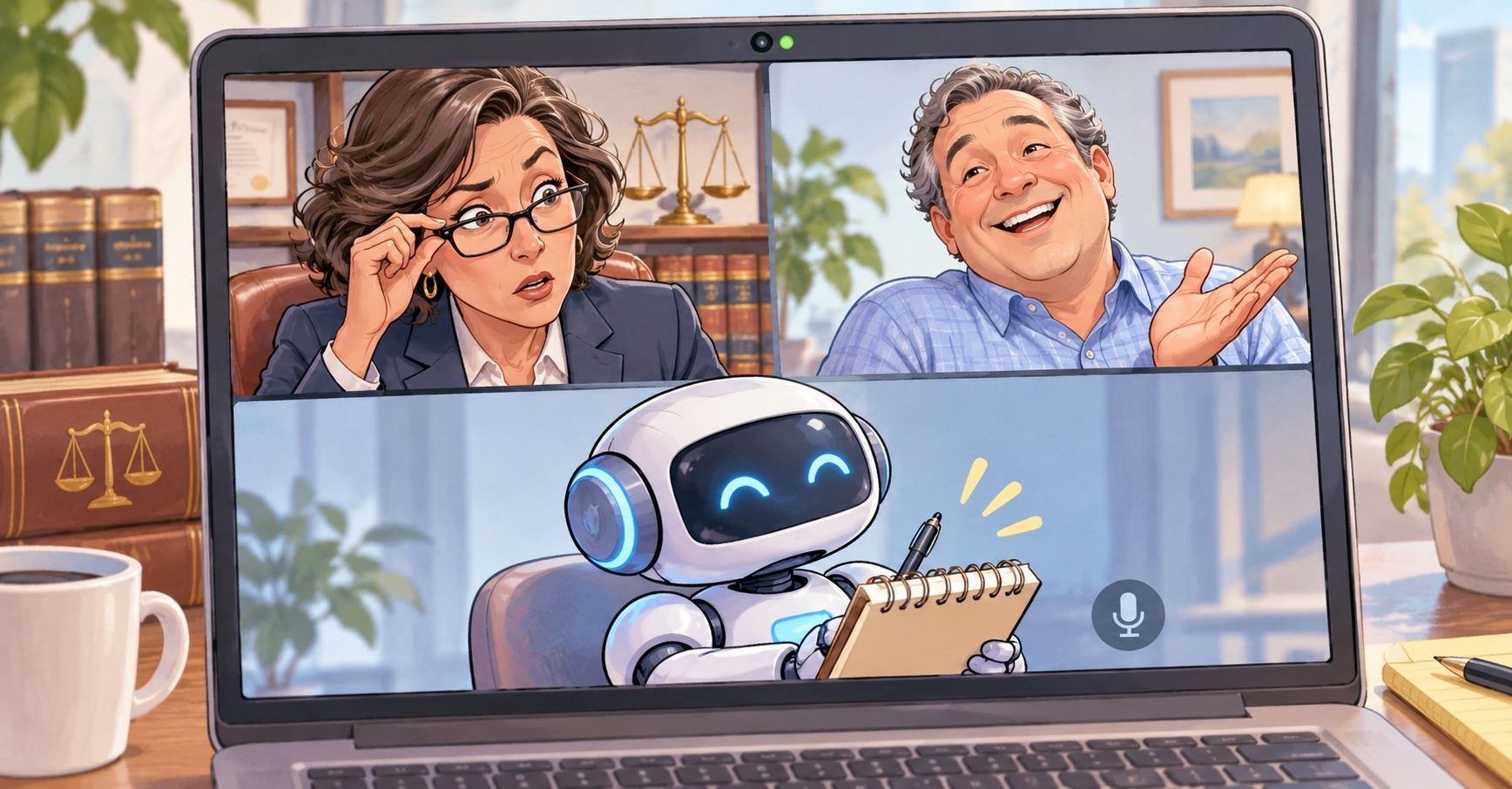
“Before we start… does anybody know who ‘Notetaker (Beta)’ is?”
Silence. Then your client, cheerfully: “Oh, that’s mine. It sends me a summary afterward. Isn’t that great?”
Great is one word for it.
AI meeting assistants have become the uninvited plus-one (sometimes it’s a plus-three) of the video call. They show up early, never talk, and “remember” everything. Then they ship it all to a vendor’s server, under terms of service nobody on the call has read.
For most meetings, that’s an etiquette question. For a lawyer and a client, it’s an ethics question, as the New York City Bar’s ethics committee made clear in Formal Opinion 2025-6 (December 2025). The Associated Press has been asking the same questions for the rest of us.
It’s just a transcript. Do I really need to ask permission?
According to the NYC Bar, yes. Clients must be notified, and their consent obtained, whenever an AI system records their calls. That holds even in New York, a one-party consent state, because the committee grounds it in the duty of loyalty and Rule 8.4(c), not wiretap law.
And by the way, many states require all-party consent anyway. The opinion notes that the AI tool can’t tell you when a recording crosses the line. That’s your department, not the bot’s. (Not mine either. I’m a computer geek forensic examiner, not a lawyer.)
Where does the recording actually go?
The opinion tells lawyers to look at where the data is stored and for how long, whether the vendor trains on it, whether you can delete it, and whether it’s retrievable in discovery. Most of that is controlled by the provider, not the firm, so lawyers should warn clients about the risk to confidentiality and privilege. 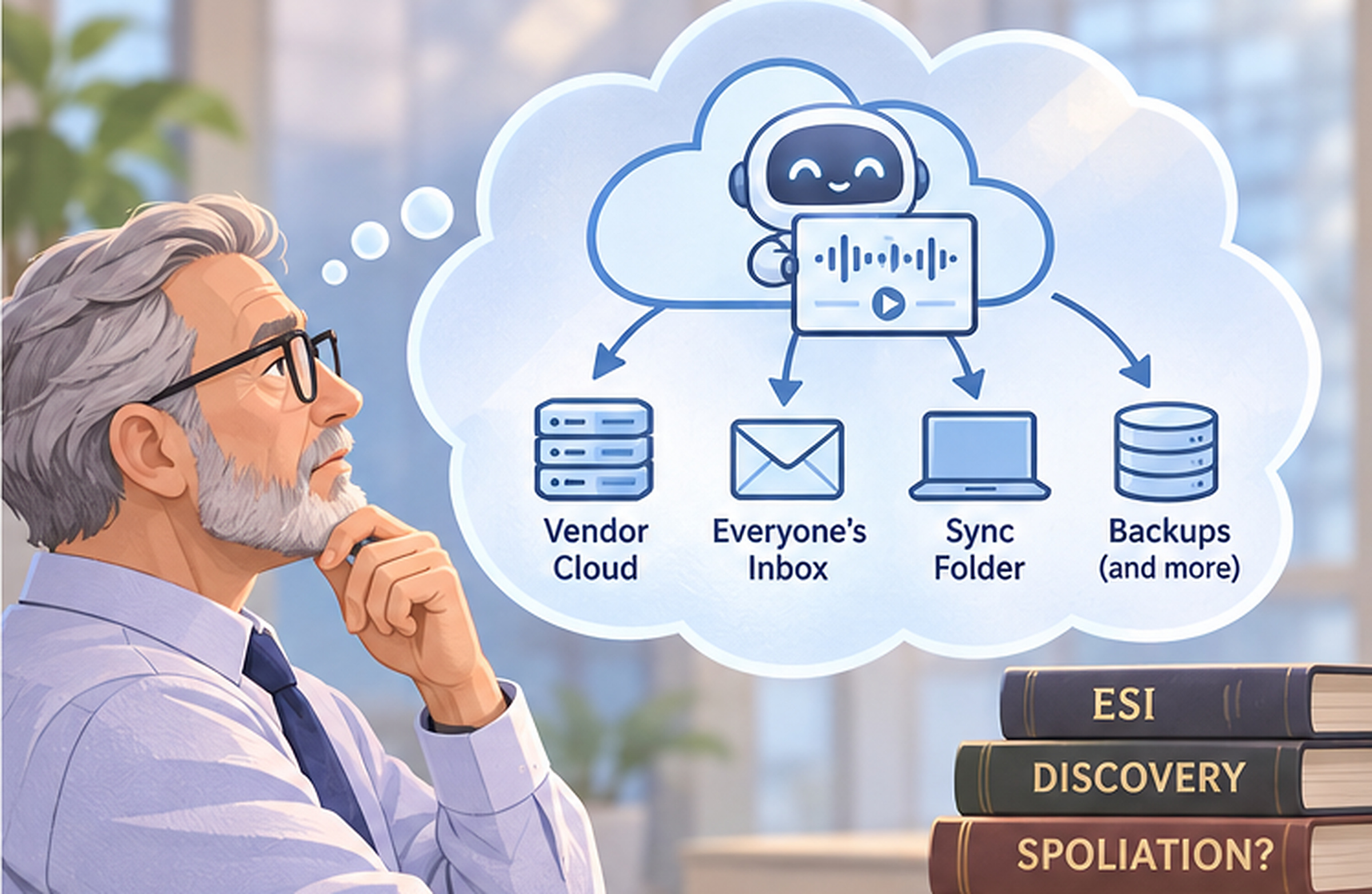
From the perspective of a forensic examiner, every recording, transcript and summary is (potentially discoverable) ESI. It has metadata. It has copies: in the vendor’s cloud, in everyone’s inbox, maybe in a sync folder on somebody’s laptop, maybe in a backup of that. If litigation hits, somebody will likely ask for it. And if it’s gone? Spoliation, anyone?
Has privilege left the building?
Good question; hazy answer: it’s unsettled. The NYC Bar doesn’t say a notetaker automatically waives privilege. It flags the risk and tells lawyers to warn clients.
But the trend is worth watching. AP reports that a New York federal judge in February ordered a criminal defendant to turn over documents he’d prepared for his lawyers, because he’d already shared them with a third party: an AI chatbot. That wasn’t a notetaker case, but the logic rhymes. Hand your privileged conversation to an outside service, and you may have to explain why it’s still privileged.
Fine, but at least the summary will be accurate, right?
Ah. About that.
AI summaries are confident, tidy and occasionally fiction. The committee calls AI’s tendency to “hallucinate” well recognized and  says lawyers should independently review any recording, transcript or summary, whoever made it. Picture a summary reading “client approved settlement” when the client said “I’d never approve that settlement.”
One dropped word, and now there’s a very confident and official-looking document saying the opposite of the truth. If a client insists on running their own notetaker, the opinion says the lawyer should disclaim responsibility for unreviewed AI summaries.
Wait, my voice is biometric data?
It sure can be. Privacy advocates quoted by AP worry that notetaker companies are building voiceprints without consent. The NYC Bar points to biometric privacy laws in Illinois, Texas, Colorado, Maryland, Oregon and Washington, some of which cover voiceprints, and says recording without knowledge and consent may run afoul of them. Your voice works like a fingerprint you leave in every meeting.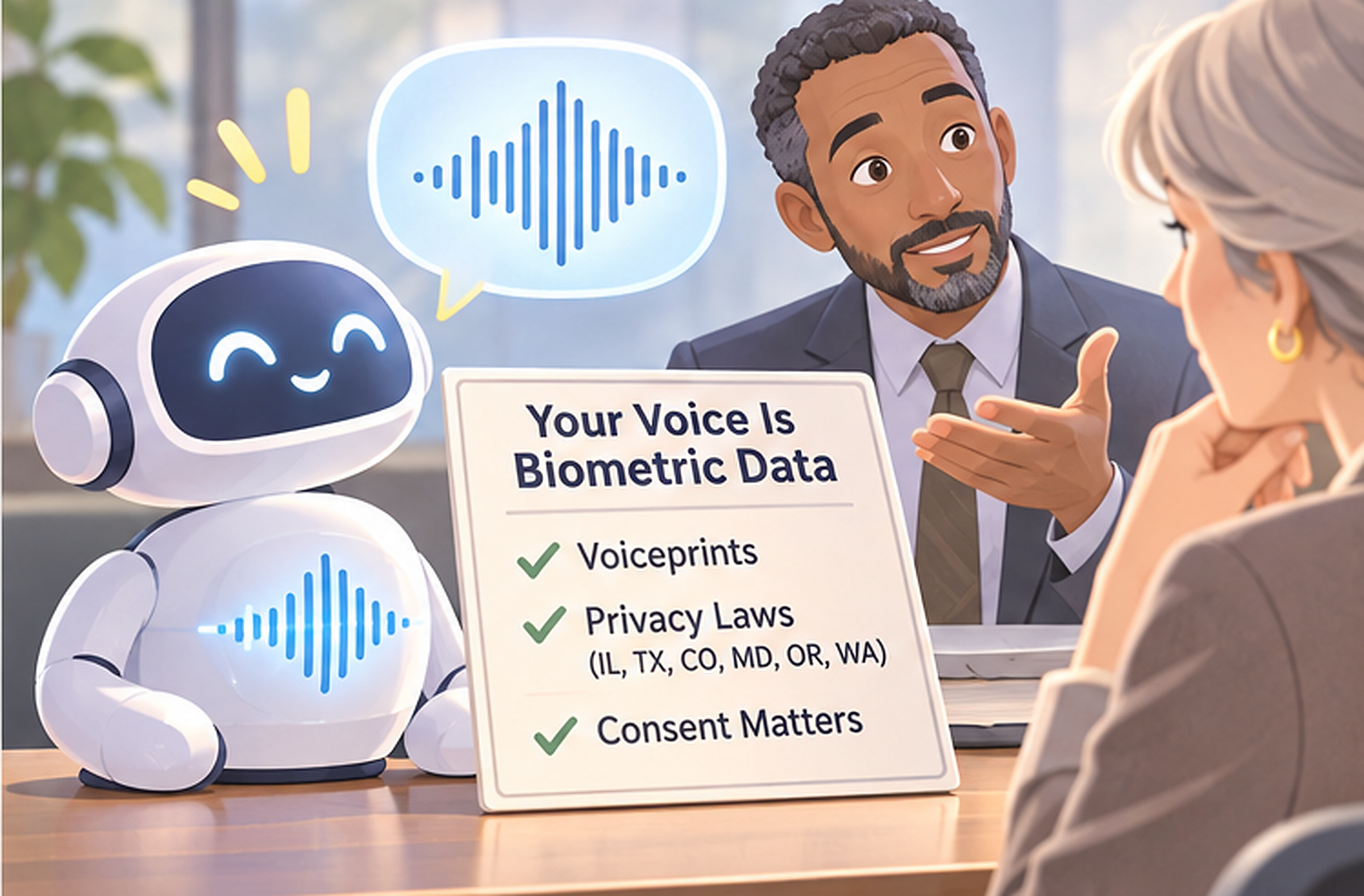
So, what to do?
- Ask first, every time. Get consent before an AI tool records. Address it in the engagement letter.
- Read the vendor terms. Retention, training, deletion. Boring, yes. Less boring than a motion to compel.
- Check the attendee list before you say anything that matters.
- Review every summary like a first-year associate’s draft: fast, helpful, and not to be trusted unsupervised. Not a bad idea to check anything AI-produced with that perspective.
- Talk to clients about their bots. Ask them to leave them off for privileged calls.
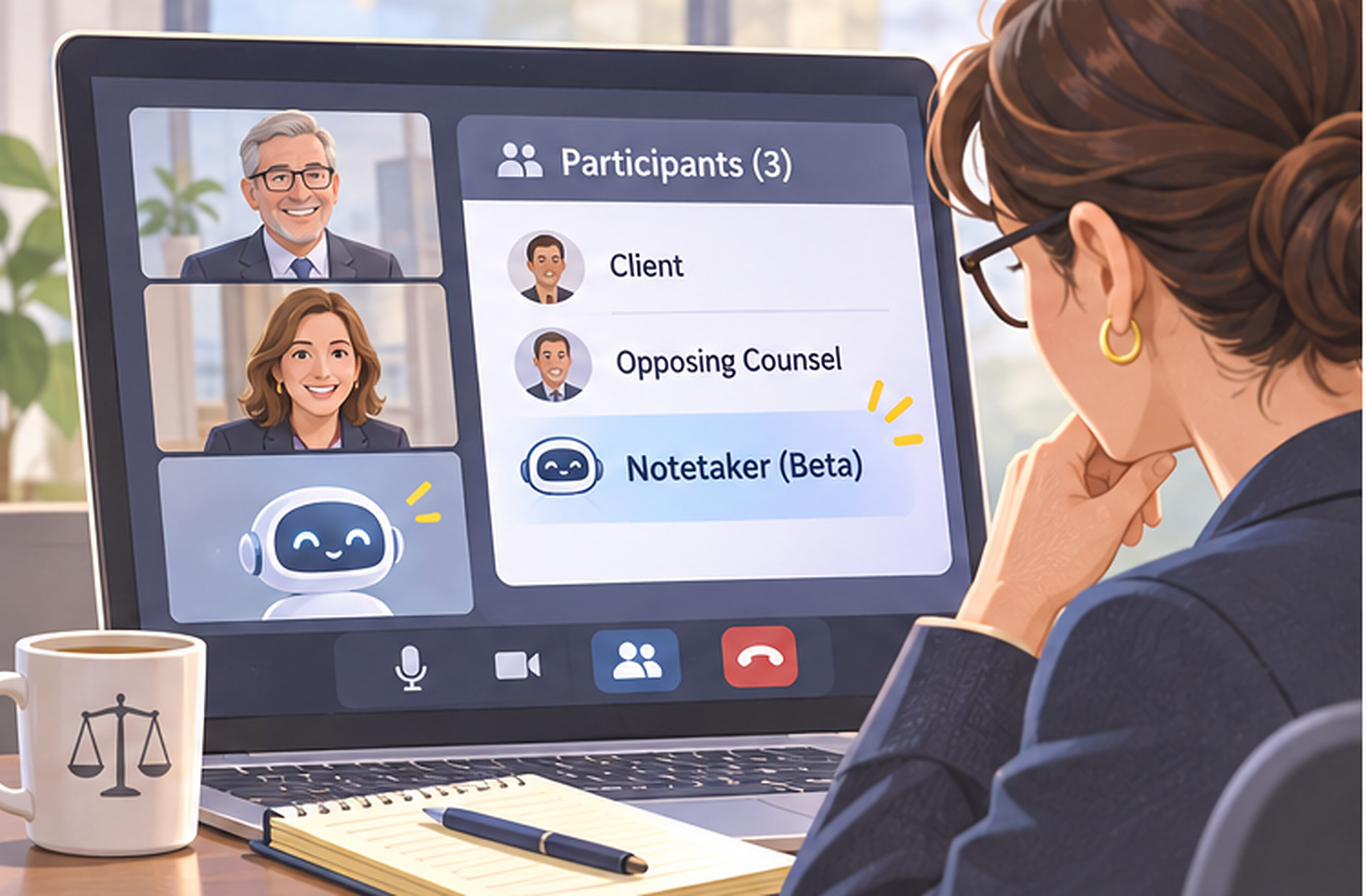 Lawyers have always worried about who might be listening at the door. The difference now is that we invite the listener in, give it a cute name and ask it to take notes.
Have you had an AI notetaker show up uninvited on a client call? What did you do? I’d love to hear about it.
Steve Burgess is a digital forensics expert witness with more than 40 years of experience and over 20,000 devices and digital media examined. He is the principal of Burgess Forensics, founded in 1985.