
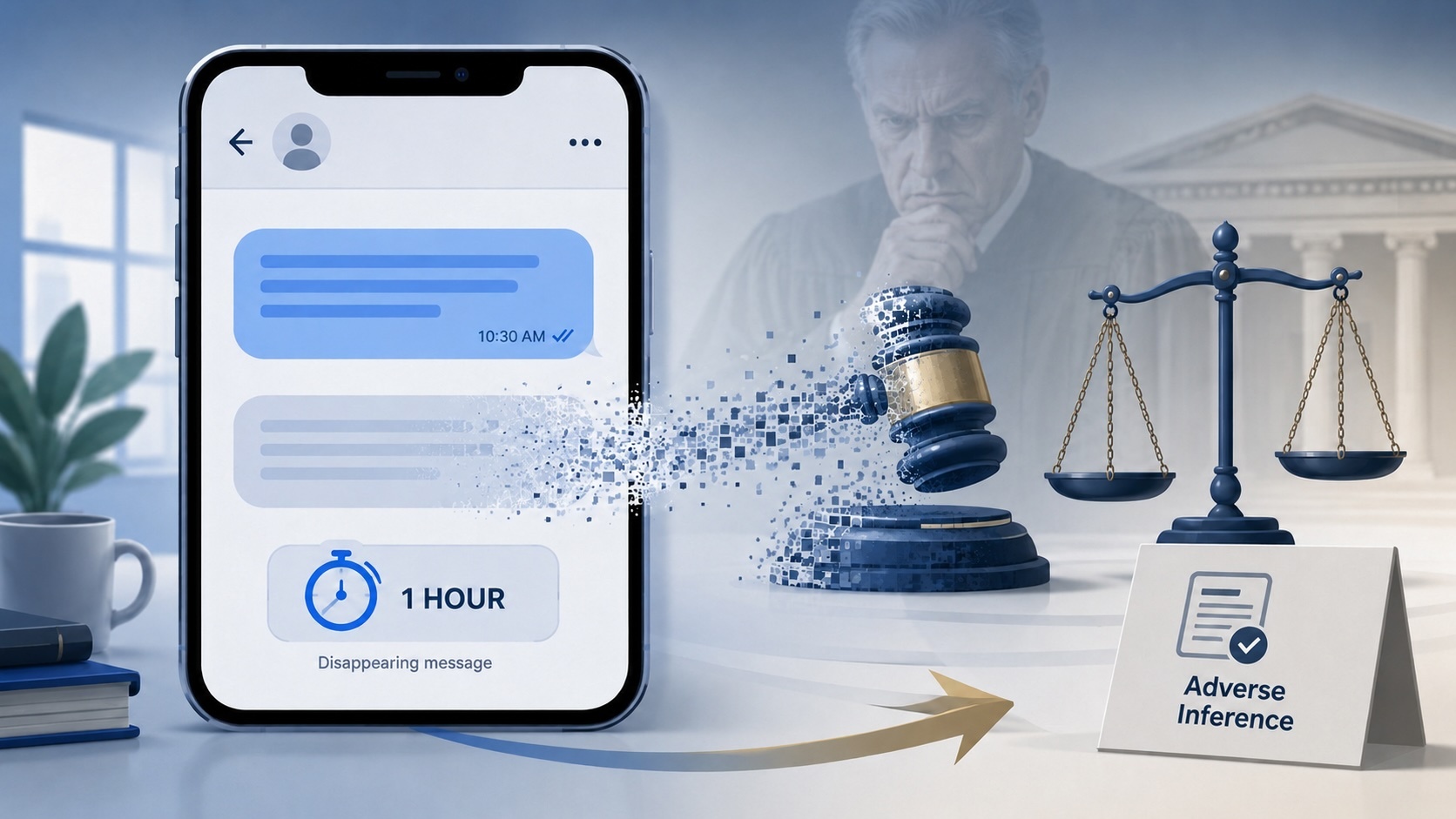
The messages were set to delete within an hour, and some of those settings were changed after a litigation hold had already landed. That was really the whole idea.
If you practice long enough, you learn that the tools change but human nature doesn’t. Caveguy Ugg didn’t want anyone to know where he buried the mammoth haunch. Today the digging stick is a setting inside Signal, and the dirt is a “disappearing messages” timer. Same instinct, better encryption.
 A million years post-Ugg, the same instinct turns up in the Delaware Court of Chancery. It’s a decision worth reading once, and worth repeating to a client twice.
Wait, isn’t the whole point of an encrypted app that the messages are gone?
Gone from the phone, maybe. Not gone from your obligations.
In In re World Wrestling Entertainment, Inc. Merger Litigation (Del. Ch., May 2026), Vice Chancellor Laster addressed exactly this. Senior people ran Signal with auto-delete turned on, after receiving litigation holds, several manually changed individual chats so messages would disappear in a little less than an hour. The court didn’t shrug. The court  held that the first hold already reached Signal communications that overlapped with the potential deal. And even apart from the hold, it found that the duty to preserve sale-related evidence had arisen by August 31, 2022. That was months before the later sale-process hold. Sophisticated parties in that situation should reasonably have anticipated litigation.
The line worth taping to your monitor: litigation holds are not self-executing. Sending the memo, and even making sure they got it, is not the same as preserving the data. Somebody has to identify the relevant apps and devices, verify the settings, and actually disable the auto-deleted function.
So, what did it cost them?
The court didn’t reach for the biggest hammer. Rather than make a default judgment or give a blanket “assume the worst” instruction to a jury, it did something more surgical. It was arguably more dangerous for the sanctioned side: it presumed certain specific facts to be true and then shifted the burden, requiring the defense to overcome those presumptions by clear and convincing evidence rather than the usual preponderance. A bit of a switcheroo on the usual burden of proof ground floor.
Read that again if you litigate. The evidentiary floor moved. That’s not a slap on the wrist.
Now, I’m a forensic examiner, not a lawyer, and the doctrine here (when the duty attaches, what sanction fits) is your department, and it varies by jurisdiction. What I can tell you is the part that lives on my side of the table: how this actually plays out in the data.
Can’t your people just recover the deleted Signal messages?
Sometimes, but not always, and not the way Professor Google’s many advisors say. Here’s what’s real.
Disappearing-message apps are built to leave little behind, but “little” is not “nothing.” Copies and traces have a way of surviving in places people forget. A forensic acquisition or Signal backup made while the data still existed. The conversation on another participant’s or linked device where some data has survived. A screenshot somebody took. Notification artifacts preserved elsewhere. A message quoted in an email. Encryption is a strong lock on the message itself. It does nothing about the copies that already walked out the door and went for a jog.
But if the content is truly gone, the forensics may not bring back the words. This matters much for setting expectations with a client. What may be able to show is the activity on the device or app artifacts: that an app was installed, that auto-delete was switched on, that a timer was shortened at a telling moment. Note that we’re talking about what the device did, not who was holding it. Putting a specific person at the keyboard is a separate and much harder question. But in a spoliation fight, showing that a message was set to vanish, and when the setting changed, can matter as much as the words that vanished.
So, what to do?
If you represent the party with the duty, the practical steps are unglamorous and they work.
Identify the apps early. Ask, in plain language, what everyone messages on — not just email and texts. Signal, WhatsApp, Snapchat, Teams, the group chat nobody mentions.
Turn off disappearing settings the moment litigation is reasonably foreseeable, and confirm that preservation is actually occurring rather than trusting that the memo did the job.
Preserve any available backups, forensic images, and secondary devices before data rolls off or is overwritten. But don’t assume an ordinary phone backup contains Signal history—or that a Signal backup captured short-lived disappearing messages. It’s a good idea to collect that before today’s backup writes over yesterday’s.
Document your preservation, not just your hold. When someone later asks what you did, “we sent a notice” is a weaker answer than “we sent a notice and confirmed the settings on every device by this date.”

None of this requires a particular level of paranoia. It requires remembering that a message built to vanish can still leave a record of having been built to vanish.
Ever had a “disappearing” conversation turn out not to be the dead end everyone assumed? I’d like to hear how it surfaced.
Steve Burgess is a digital forensics expert witness with more than 40 years of experience and over 20,000 devices and digital media examined. He is the principal of Burgess Forensics, founded in 1985.
Burgess Forensics: (866) 345-3345 | steve@burgessforensics.com
Don’t miss a single issue of our informative newsletter … Subscribe now!